
Life Settlement Fair Market Value: A 2026 Guide

Table of Contents
- What Is Life Settlement Fair Market Value?
- Life Settlement Valuation Factors That Shape Your Policy's Worth
- How Much Is My Life Insurance Policy Worth to Sell?
- Life Settlement vs. Cash Surrender Value: Key Differences
- Fair Market Value vs. Actual Settlement Offers: What to Expect
- How to Compare Life Settlement Offers and Assess Quality
- Frequently Asked Questions
Last Updated: October 19, 2026
What Is Life Settlement Fair Market Value?
Life settlement fair market value is the price a third-party buyer would reasonably pay for your life insurance policy on the open market. It reflects what your policy is worth to someone other than the insurance company, typically more than what the insurer would pay if you surrendered it, but less than the full death benefit. (Source: a 2026 industry report)
Think of it like selling a used car: the dealer's trade-in offer isn't what a private buyer might pay.
At Eagles Soar Enterprises, LLC, we've spent over 41 years helping policyholders understand this distinction.
Fair market value accounts for your age, health status, the policy's face amount, future premium obligations, and current market conditions. It's not a fixed formula but the result of competitive bidding among multiple buyers who each evaluate your policy independently.
Life Settlement Valuation Factors That Shape Your Policy's Worth
Buyers assessing life settlement fair market value aren't looking at one number; they're weighing risk, cash flow, and return potential. The factors below are the same inputs a buyer's underwriter uses, and they interact, a change in one often changes the weight of another.
Age and Life Expectancy
Your age and health status are among the most influential factors in determining what your policy is worth. Buyers use medical underwriting to estimate your life expectancy.
A 75-year-old in good health might see a very different valuation than a 68-year-old with multiple health conditions.
Expect buyers to request medical records, conduct phone interviews, and sometimes require a medical exam, the foundation of an accurate valuation.
Policy Type and Face Amount
Whole life and universal life policies typically command higher valuations than term policies, because they have cash value components and longer potential lifespans.
The face amount matters too: a $500,000 policy draws more interest than a $100,000 policy because the potential death benefit is larger.
A universal life policy with flexible premiums presents different cash flow dynamics than a whole life policy with fixed premiums, and buyers price these differences into their offers.
Premium Costs and Future Obligations
Here's where many policyholders get surprised: the buyer takes over your premium payments after the settlement closes.
If your policy requires $5,000 annually in premiums and you're expected to live another 15 years, that's $75,000 in future obligations the buyer must fund.
Some premiums increase with age, others are fixed, and some can drop. Each scenario changes the financial picture for a buyer, and therefore what they'll pay.
How the Inputs Combine: A Transparent Walkthrough
Here is a clearly labeled hypothetical to illustrate the mechanics. It is not an offer, a quote, or a prediction, and real buyers will reach different conclusions.
Assume a policy with a $500,000 death benefit, a $5,000 annual premium, and an estimated life expectancy of 10 years. A buyer's simplified model might look like this:
- Project future premiums. $5,000 per year × 10 years = $50,000 in premium outlay the buyer must fund.
- Discount the death benefit to present value. The buyer applies a discount rate reflecting its cost of capital and risk. At a hypothetical 12% discount rate over 10 years, the present value of $500,000 is roughly $161,000.
- Subtract the present value of premiums. The $50,000 in future premiums, discounted at the same rate, is roughly $28,000.
- Apply a risk and profit margin. The buyer reserves a return for uncertainty in life expectancy and policy performance, perhaps 20% of the remaining spread.
- Arrive at an indicative range. The result is a range, not a point estimate, because every input is uncertain.
This is why two buyers can look at the same policy and produce offers differing by tens of thousands of dollars, different life expectancy estimates, discount rates, or assumptions about how long the policy can be sustained.
Sensitivity: Why Small Assumption Changes Move the Number
Valuation uncertainty is not a flaw in the process, it is the process. A one-year change in estimated life expectancy can shift a buyer's premium projection by thousands of dollars, and a change in a universal life policy's crediting rate can change whether the policy remains funded at all.
Buyers typically run multiple scenarios rather than a single projection. When you receive offers, ask each buyer what life expectancy estimate and premium funding assumption underlies its number, that question tells you more than the headline figure.
How Much Is My Life Insurance Policy Worth to Sell?
Determining your policy's value requires more than guessing. It requires structured analysis.
Using a Life Insurance Policy Value Calculator
A policy value calculator is a starting point, not a final answer. These tools estimate value from face amount, policy type, age, and health status, giving you a ballpark range.
But calculators can't account for unusual policy features, non-standard underwriting, or daily market shifts.
The real valuation happens when you work with professionals who can access the settlement market. Eagles Soar Enterprises, LLC offers a [Free Life Insurance Policy Evaluation](https://insurancescored.com/contact) that goes beyond any calculator.
Life Settlement vs. Cash Surrender Value: Key Differences
Your insurance company will tell you what they'll pay if you surrender the policy. That's cash surrender value. It's typically far less than fair market value in the settlement market.
Cash surrender value is your equity in the policy minus fees and penalties.
Book A Free LIfe Policy Evaluation →
Life settlement fair market value emerges from competition. When multiple buyers bid on your policy, they're trying to win your business. That competition drives prices up.
Fair Market Value vs. Actual Settlement Offers: What to Expect
Here's an important reality: fair market value is a concept.
Fair market value represents what the market would theoretically pay if your policy were auctioned openly with full information.
One buyer might offer $120,000. Another might offer $145,000. A third might pass entirely.
This is why shopping around isn't just recommended, it's essential. The difference between the lowest and highest offer you receive can be substantial.
How to Compare Life Settlement Offers and Assess Quality
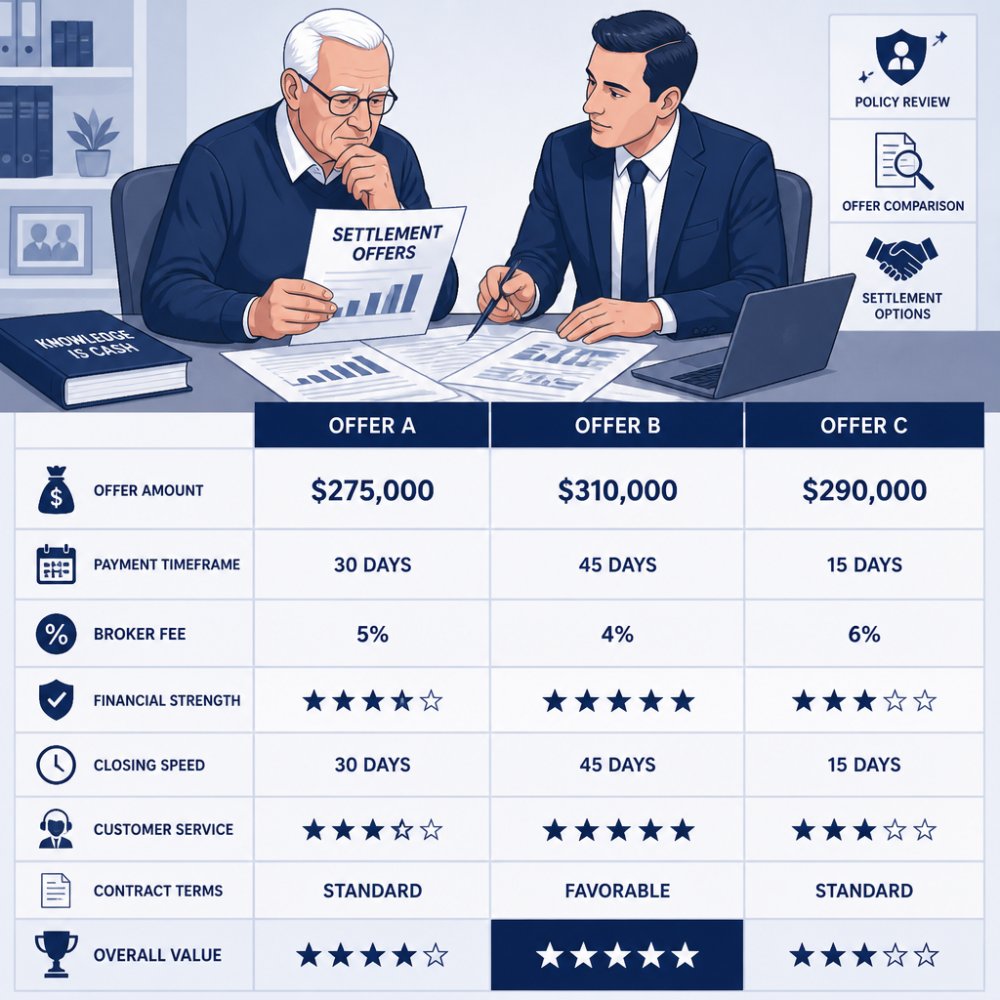
When you receive multiple offers, you're not just comparing numbers, you're evaluating the buyers behind them and their terms. This section gives you a consistent method to compare offers on equal footing.
Step 1: Normalize Every Offer to Net Proceeds
Gross offer figures are not comparable. Ask each buyer for a written breakdown showing the gross offer, every fee or cost deducted, and the net amount you would receive.
A higher gross offer with larger deductions can produce lower net proceeds than a slightly lower gross offer with minimal deductions. The only number that matters to your bank account is net proceeds.
Step 2: Compare the Terms Behind the Number
Price is one term among several. For each offer, confirm:
- Funding timeline. How many days from signing to funds arriving?
- Contingencies. What happens if your health improves or declines before closing? Does the offer change?
- Premium responsibility during processing. Who pays premiums while the transaction is pending?
A slightly lower offer with a short funding timeline and no contingencies may beat a higher offer that can be repriced before closing.
Step 3: Assess the Quality of the Bidding Process
Competitive bidding is what turns an estimate into a market price. Ask how many buyers actually reviewed your policy, not how many are "in the network." A process that solicits bids from many funders simultaneously produces a more reliable price signal than a single buyer's quote.
Questions that reveal auction quality:
- How many buyers submitted a bid, and how many passed?
- Were all buyers given the same medical and policy information?
- Is the process a formal auction with a defined bid deadline, or an informal round of quotes?
Step 4: Evaluate the Buyer's Track Record and Compliance
Check how long the buyer has operated in the settlement market and whether it is licensed or registered as required in your state, and ask for references. A buyer offering the highest number but with a thin history or evasive compliance answers is not a safe counterparty.
Review the offer letter for clarity on net proceeds, what you'll actually receive after all fees and costs. Some gross figures shrink considerably once fees are deducted.
Step 5: Score Offers Side by Side
Use a simple scoring sheet. Weight net proceeds highest, then funding speed, then term certainty, then buyer track record. Score each offer from 1 to 5 on each criterion, multiply by your weights, and total. The exercise forces you to state what you actually value instead of defaulting to the biggest headline number.
The quality of the buyer matters as much as the offer itself. You're entering a long-term relationship, they'll own your policy until you pass away. Choose someone you trust to manage that responsibly.
Frequently Asked Questions
What does fair market value mean in a life settlement?
Fair market value in a life settlement is the price a willing buyer would pay for your policy in an open market, assuming both parties have reasonable knowledge of the facts. It reflects what your policy is worth based on its death benefit, remaining premiums, your health status, and life expectancy. This value typically exceeds the cash surrender value your insurance company would offer, making it an attractive option for policyholders seeking to unlock more of their policy's value.
How is the fair market value of a life insurance policy determined?
Fair market value is calculated using several key factors: your age and life expectancy, the policy's face amount and type, future premium obligations, and current market conditions. Life settlement providers conduct medical underwriting to assess your health status, then use valuation methodologies that estimate the likely return on investment for a buyer. The process involves competitive bidding among multiple third-party buyers, which helps establish a more accurate market value for your specific policy.
What factors affect a life settlement valuation?
Major valuation factors include your age, health status and life expectancy, the policy's face amount and type (whole life, universal life, or term), remaining premium payments and their cost, and policy performance history. Health conditions, smoking status, and medical records significantly influence life expectancy estimates. The policy's features, such as guaranteed insurability or enhanced death benefits, also affect valuation. Buyers assess these factors to determine the net proceeds they could receive after paying future premiums until the death benefit is claimed.
Is fair market value the same as a life settlement offer?
Fair market value and an actual settlement offer are related but not identical. Fair market value represents what your policy should be worth in the market based on objective factors. An actual offer from a buyer reflects fair market value but may also include that buyer's specific underwriting conclusions, risk assessment, and profit margin. Multiple offers allow you to see how closely buyers' valuations align with fair market value. Getting several competitive bids helps you confirm whether an offer is reasonable or if you should shop around further.
How do I know if I'm getting fair market value and not being lowballed?
The best protection is to obtain multiple competitive offers from different life settlement providers and buyers. Fair market value emerges through competitive bidding, so comparing offers shows you the range of what buyers are willing to pay. Work with experienced professionals who have a network of multiple third-party funders, which increases competition and transparency. Ask each provider to explain their valuation methodology and the factors driving their offer. A reputable provider with connections to numerous buyers can help ensure you receive offers that reflect true market value.
Can I get a life settlement valuation without accepting an offer?
Yes. A free, no-obligation policy valuation allows you to understand your policy's potential value without committing to a sale. This valuation gives you a realistic picture of what your policy might be worth in a life settlement transaction. You can review the valuation, compare it against your cash surrender value and premium costs, and decide whether selling makes sense for your financial situation. There is no cost or commitment to obtain this valuation, making it a risk-free way to explore your options before making a final decision.
What information is needed to value a life insurance policy?
To value your policy, providers need your policy details (type, face amount, issue date, premiums), your personal health information and medical history, current age and life expectancy estimate, and details about future premium obligations. They may request recent medical records or conduct a medical review. For certain policies like VGLI from military service, they may need military discharge documents or VA information. The more complete and accurate the information you provide, the more precise the valuation will be.
How long does the life settlement valuation process take?
A preliminary valuation often takes a few days to a week once you provide your policy details and medical information. If medical records need to be obtained or reviewed, the timeline may extend. The full process from initial valuation through receiving competitive offers typically takes 2-4 weeks, depending on how quickly you provide documentation and how thorough the medical underwriting is. If you need cash relatively soon, communicating your timeline to your provider helps them prioritize your case and move efficiently through each stage.
Ready to Find Out What Your Policy Is Worth?
Get a free, no-obligation appraisal from Eagles Soar Enterprises.
Schedule Your Free Policy Review